China Top 10 EV Chargers for Apartments Can I Install One?

Time:2026-11-15 Author:Aria
0%

Apartment living does not automatically rule out electric-vehicle charging. But installation depends on more than choosing a charger. Your parking space, building wiring, electrical capacity, and property-management approval all matter. Can I install an EV charger if I live in an apartment? Often, it may be possible, but the answer depends on the building and local requirements.

China’s charging network is expanding quickly. The China Electric Vehicle Charging Infrastructure Promotion Alliance reported 12.82 million charging facilities nationwide by the end of 2024, including about 9.23 million private charging points. These figures show strong growth, yet they do not mean every apartment has suitable wiring or a dedicated parking bay. That is the practical gap many buyers encounter.

This guide compares ten EV chargers suited to apartment use, with attention to charging speed, connector compatibility, smart controls, and installation needs. A compact wall-mounted unit may fit beside a parking space, while a shared charger could better serve residents without assigned bays. Before buying, ask building management about approval, check whether the circuit can support the load, and have a qualified installer assess the site. Small details matter. A charger’s advertised power is not always the power your building can provide. And honestly, product rankings cannot replace a site inspection.
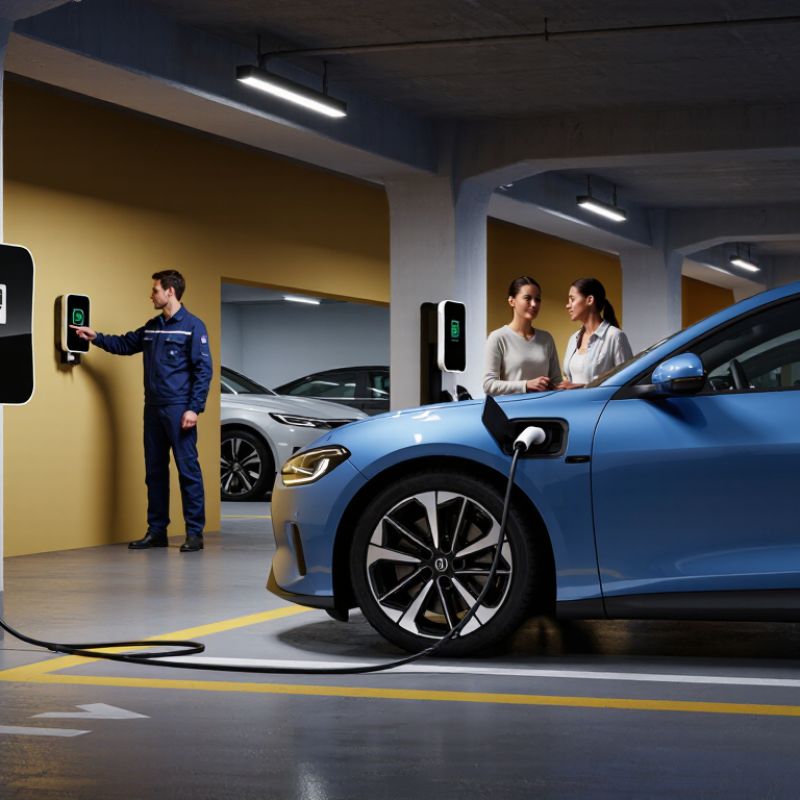
China Top 10 EV Chargers for Apartments Can I Install One?

China’s Apartment EV Charging Basics: 220 V Supply and 7 kW AC Charging

A 220 V supply is common in Chinese apartments, and it can support home EV charging. A 7 kW AC charger typically draws about 32 amps on a single-phase circuit. That is a substantial, steady load, not a small appliance. The apartment’s existing wiring, meter capacity, and parking-space layout all matter. It can work. But a 220 V socket alone does not prove the circuit is suitable.

Before choosing a charger, ask a qualified electrician to check the cable size, breaker, grounding, and available electrical capacity. A dedicated circuit is usually preferable to sharing power with household equipment. Building management and the local electricity provider may also need to confirm the installation route and connection arrangements. Some garages have long cable runs or limited capacity, which can change the cost and feasibility. A neat-looking setup is not always a safe one.

Tips: Keep the charger close to the parking space, protect cables from vehicle traffic, and use equipment rated for outdoor conditions if exposed to rain. Request a written load assessment before installation. I would not assume every apartment can deliver 7 kW; sometimes a lower charging rate is the more practical choice.

How to Compare China’s Top 10 Apartment EV Chargers by Power and Protection

When comparing China’s top 10 apartment EV chargers, separate rated power from usable power. A 7 kW AC unit may suit overnight parking, while 11 or 22 kW models need compatible vehicle charging and sufficient building capacity. Three-phase supply is not guaranteed in every parking space. Check whether the charger supports dynamic load management, so several cars can charge without exceeding the shared supply. A higher rating looks attractive on paper. It may not help at home.

Protection deserves equal weight. Compare residual-current detection, overcurrent and overtemperature safeguards, enclosure ratings, and fault alerts. IP ratings describe resistance to dust and water, but they do not prove safe installation in a particular garage. The International Energy Agency’s Global EV Outlook 2024 reports that public charging points grew about 40% in 2023, with China accounting for roughly 70% of the global stock. That growth makes clear specifications useful, not interchangeable.

Ask for test documentation tied to applicable electrical standards, and have the building’s supply and wiring assessed by a qualified installer. A tidy specification sheet can still miss site conditions. That part is easy to overlook.

Can You Install One? Check Parking Rights, Wiring, and 32 A Capacity

Can you install an EV charger in an apartment? Often, but the parking space and electrical route matter as much as the charger. China’s National Energy Administration reported 12.82 million charging facilities nationwide at the end of 2024, including 9.23 million private facilities. That growth shows home charging is common, not that every apartment bay is ready.

Check who controls your parking space and get written approval before buying equipment. A deeded space, a rented bay, and a shared space can involve different permissions. Ask the property manager where a dedicated cable can run, whether the meter can be upgraded, and who pays for trenching or cable trays. Small details matter. A locked electrical room can stall an otherwise simple installation.

Then have a qualified electrician inspect the supply, cable length, earthing, and protective devices. At China’s nominal 220 volts, a 32-amp charger draws about 7.0 kW; the building must support that continuous load without overloading shared wiring. The IEA’s Global EV Outlook 2024 reports more than four million public charging points worldwide in 2023, but public access does not prove your private circuit is adequate. I would not treat “32 A compatible” on a product label as a site check. Ask for a load assessment and written installation plan before committing.

Installation Approvals, GB/T 18487.1 Compliance, and Fire-Safety Requirements

Installing an EV charger in an apartment building is possible, but permission comes before equipment selection. Ask the property manager or owners’ committee for written approval, and confirm whether the parking space is privately assigned. A qualified electrician should check the building’s supply capacity, cable route, metering, and protection requirements. A spare breaker does not prove the system can support overnight charging.

Check that the proposed equipment complies with the applicable edition of GB/T 18487.1, then verify that its installation suits the site. Compliance is not approval to drill through a wall or connect to shared wiring. Keep chargers and cables clear of escape routes, doors, and vehicle paths. Have any wall penetrations properly sealed, and follow the building’s fire-safety plan for equipment location and emergency isolation.

No extension cords.

In practice, cable routing can be the hardest part, especially in older garages. I would ask for the electrician’s load assessment and installation plan in writing; paperwork can feel tedious, but it prevents assumptions from becoming expensive repairs. Fire and electrical requirements may vary by building and locality, so confirm details with the responsible property and safety professionals.

Charging Time, Load Management, and Costs: Compare 7 kW with 11 kW AC

For apartment charging, 11 kW is not automatically the better choice. A 7 kW unit can refill a typical 60 kWh battery overnight, while 11 kW may shorten the session. Using 90% effective charging efficiency, the rough times are 9.5 hours and 6 hours. Real results vary with the vehicle’s onboard charger, battery temperature, and starting charge. The U.S. Department of Energy’s Alternative Fuels Data Center describes Level 2 charging across a broad power range, underscoring that the car and electrical supply both set the limit.

That difference matters. An 11 kW setup commonly needs three-phase power; many apartments do not have suitable capacity at the parking space. A licensed electrical assessment should check the panel, feeder, and building peak load before installation. Smart load management can share available capacity among chargers and reduce the need for costly electrical upgrades. The International Energy Agency’s Global EV Outlook 2024 discusses smart charging as a way to manage charging demand.

Costs depend less on the charger’s headline power than on the wiring route, panel capacity, permits, and any shared infrastructure. A short cable run may be straightforward; a distant garage can change the quote sharply. Ask for separate estimates for 7 kW, 11 kW, and managed charging. I would not assume the fastest option pays back. Overnight dwell time often makes 7 kW enough, though that judgment deserves a real usage check.

China Top 10 EV Chargers for Apartments: Can I Install One? Charging Time, Load Management, and Costs — Compare 7 kW with 11 kW AC
Apartment charging setup Rated AC power Typical supply Estimated 10–80% time* Load management Apartment considerations Indicative installed cost (CNY)**
1. Basic dedicated wall charger 7 kW Single-phase, about 220 V / 32 A About 6.7 hours None; dedicated circuit required A practical choice where the parking space has an approved, adequately sized supply. ¥3,000–¥8,000
2. 7 kW charger with dynamic load balancing Up to 7 kW Single-phase, about 220 V / 32 A About 6.7 hours at full output; longer if power is reduced Automatically reduces charging when household demand rises Useful when the available electrical capacity is limited; installation must support the control system. ¥4,500–¥11,000
3. Shared 7 kW charging with group load control Up to 7 kW per active outlet Shared building feeder; capacity-dependent About 6.7 hours at 7 kW; potentially longer when sharing power Distributes available power among connected vehicles Requires building approval and a coordinated system for multiple parking spaces. ¥5,000–¥12,000 per parking space
4. 7 kW scheduled off-peak charger 7 kW Single-phase, about 220 V / 32 A About 6.7 hours of charging; start time can be scheduled Timed charging; does not by itself increase site capacity Can shift charging to a preferred tariff period where the local tariff offers one. ¥3,500–¥9,000
5. 7 kW installation with a longer cable route 7 kW Single-phase, about 220 V / 32 A About 6.7 hours Optional; depends on the selected system Long cable runs, fire-rated routes, and extra civil work can raise the installation cost. ¥5,000–¥15,000
6. Dedicated three-phase wall charger 11 kW Three-phase, about 380 V / 16 A per phase About 4.2 hours None; dedicated three-phase capacity required Only worthwhile if the parking supply and the vehicle’s onboard AC charger both support 11 kW. ¥4,500–¥10,000
7. 11 kW charger with dynamic load balancing Up to 11 kW Three-phase, about 380 V / 16 A per phase About 4.2 hours at full output; longer if power is reduced Adjusts charging to stay within monitored site limits Can help manage constrained capacity, but does not replace approval or a suitable three-phase connection. ¥6,000–¥13,000
8. Shared 11 kW charging with group load control Up to 11 kW per outlet Shared three-phase feeder; capacity-dependent About 4.2 hours at 11 kW; potentially longer when sharing power Allocates available power across multiple charging points A building-level option; requires coordinated design, metering, and property approval. ¥7,000–¥16,000 per parking space
9. 11 kW installation requiring supply upgrades 11 kW, subject to approved capacity Three-phase connection; upgrades may be needed About 4.2 hours once operating at 11 kW Recommended where multiple loads or chargers share capacity Transformer, feeder, meter, or building works can require separate approval and substantially increase cost. ¥10,000–¥30,000+; major works may cost more
10. Portable AC EVSE on a verified dedicated circuit About 3.5 kW Single-phase, typically about 220 V / 16 A About 13.3 hours Usually limited; check the equipment’s features Use only with a circuit assessed for continuous EV charging; an ordinary shared household socket may be unsuitable. ¥1,000–¥4,000
Notes: *Charging-time estimates assume a 60 kWh battery charged from 10% to 80%, about 10% charging losses, and a vehicle able to accept the stated AC power. Actual time depends on the vehicle’s onboard charger, battery temperature, charging conditions, and any power sharing. An 11 kW unit will not charge faster if the vehicle is limited to 7 kW. **Cost ranges are indicative estimates in China for equipment and typical installation, not quotations; cable distance, site conditions, local requirements, and building upgrades can change the total. Before installation, obtain property-management approval, confirm available supply and metering with the relevant parties, and have a qualified electrician verify the circuit and protection requirements.

FAQS

Can a 220 V apartment supply support a 7 kW charger?

Often, but voltage alone proves little. A 7 kW unit draws about 32 amps on single-phase power. Have an electrician check the wiring, meter capacity, grounding, and breaker.

Why might 7 kW charging not work in my parking space?

Long cable runs, limited building capacity, or shared circuits can restrict charging. A lower rate may be more practical. It happens.

What should an electrician inspect before installation?

Ask them to check cable size, breaker, grounding, available capacity, and the route to your parking space. Request a written load assessment. It helps.

Do apartment buildings usually need to approve a charger installation?

Ask property management or the owners’ committee for written approval. Confirm that your parking space is assigned to you, and clarify metering and cable routes. A spare breaker proves nothing about capacity.

Is an 11 kW or 22 kW charger always better than a 7 kW model?

No. Higher-rated chargers may need three-phase supply, a compatible vehicle, and more building capacity. For overnight parking, 7 kW may be enough.

Which safety features and specifications should I compare?

Check residual-current detection, overcurrent and overtemperature protection, fault alerts, and enclosure ratings. IP ratings describe dust and water resistance, not site safety. Specs can miss details.

What does GB/T 18487.1 compliance mean for an apartment charger?

Verify compliance with the applicable edition, then confirm the installation suits the site. Compliance does not grant permission to drill walls or use shared wiring. Easy to overlook.

How should cables and equipment be placed in a shared garage?

Keep cables away from vehicle paths, doors, and escape routes. Use outdoor-rated equipment where rain exposure is possible, and seal wall openings properly. No extension cords. Confirm emergency isolation and fire-safety arrangements with building professionals.

Conclusion

This guide explains the basics of apartment EV charging in China, where a 220 V supply commonly supports 7 kW AC charging. It outlines how to compare ten types of apartment chargers by output, electrical protection, and suitability for shared or private parking. Rather than focusing on a particular model, it highlights practical features to review, including current limits, safety protections, and compatibility with the vehicle and building’s electrical system.

Can I install an EV charger if I live in an apartment? The answer depends on your parking rights, available wiring, and whether the supply can safely support a 32 A circuit. The guide also covers the usual approval steps, GB/T 18487.1 compliance, and fire-safety considerations. Finally, it compares 7 kW and 11 kW AC charging in terms of charging time, installation demands, load management, and running costs, helping residents assess a safe and practical setup before proceeding.

Aria

Aria

Aria is a dedicated marketing professional with a deep passion for innovative strategies and a keen understanding of our company's product offerings. With a wealth of experience in the industry, Aria excels at crafting engaging content that highlights the unique features and benefits of our......