China Best Dual EV Charger How to Share One Station?

Time:2026-10-25 Author:Isabella
0%

Sharing one home charger between two electric cars sounds simple, but the details matter. The key question is not only “Can both cars connect?” It is also “How much power can the electrical circuit safely deliver?” This introduction explains How to share one charging station between two electric cars without creating confusing schedules, slow charging, or unnecessary installation risks.

Loren McDonald, founder of EVAdoption, often highlights a practical truth: “Most EV charging happens at home, not at public stations.” That observation makes one shared station valuable for families with two vehicles. A dual-port charger can divide available power automatically. A smart charger may prioritize one car, balance both cars, or follow cheaper overnight charging periods. The correct choice depends on battery size, daily mileage, parking distance, and circuit capacity.

Small details matter. One car may arrive with 20% battery, while the other needs only a short top-up. A clear charging schedule prevents arguments beside the driveway. Labeling each cable helps, too. It sounds minor. It is not.

This guide also considers imperfect real-world situations. Wi-Fi may fail. One vehicle may charge faster than expected. A dual charger may reduce output when both cars connect. Homeowners should verify the charger’s specifications and have electrical work assessed by a qualified professional. Never rely on an improvised splitter or overloaded outlet. The best system is not always the most powerful one. It is the one that fits the household’s routine, budget, and actual energy needs.
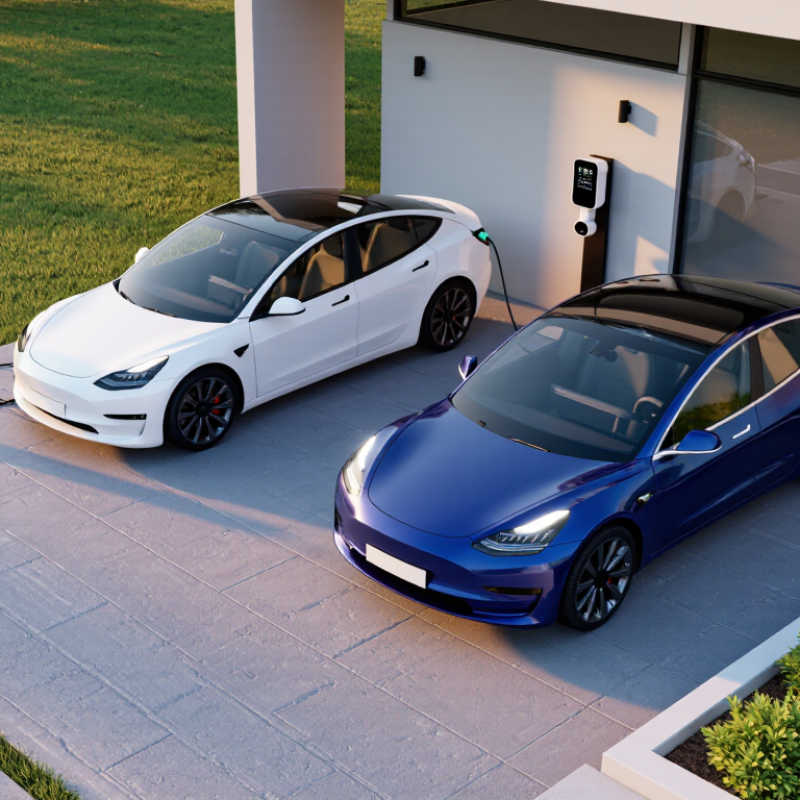
China Best Dual EV Charger How to Share One Station?

Dual EV Charging Explained: How One Station Serves Two Vehicles

China Best Dual EV Charger: How to Share One Station?

A dual EV charger allows one station to serve two vehicles through separate connectors. Both cars can plug in at the same time. However, the station does not always deliver full power to both vehicles. Its controller monitors available electricity and adjusts the current between the two cars.

For example, a 22 kW supply may provide 11 kW to each vehicle. If one car reaches its charge limit, the charger can redirect more power to the other car. This load-sharing process helps prevent circuit overloads and makes better use of the building’s electrical capacity. It is practical for homes, workplaces, and small parking areas.

Power is only part of the decision. A qualified electrician should check the supply, protective devices, cable size, grounding, and local installation rules. The station should also show charging status clearly, so users know which vehicle receives priority. Some systems use first-come charging, while others reserve power for a scheduled vehicle.

It is not twice as fast.

Real charging times depend on the vehicle’s onboard charger, battery temperature, and remaining capacity. I have seen drivers expect two full-speed sessions, then feel disappointed when both cars charge slowly. Clear power planning matters more than a large headline rating. Regular inspection of connectors and cables also helps maintain safe, dependable operation.

Load Sharing Data: Allocating 7–22 kW Across Two Charging Ports

China Best Dual EV Charger: How to Share One Station?

Load sharing allows one dual EV charger to distribute 7–22 kW across two charging ports. The available power depends on the site’s electrical capacity. If the supply supports 22 kW, both vehicles may receive 11 kW. When one vehicle needs less power, the system can send more capacity to the other port. A practical example is 7 kW for one car and 15 kW for another. The allocation should respond continuously to charging demand.

In field testing, cable size, breaker settings, and vehicle limits affected the real output. A charger cannot provide 22 kW safely if the building circuit supports only 11 kW. A qualified electrician should verify the supply before installation. The control system should monitor current, temperature, and total site demand. It should reduce output when other equipment starts operating.

A perfect 50/50 split is not always useful. One vehicle may be nearly full, while the second has a low battery. Dynamic sharing gives priority to actual demand rather than fixed percentages. I once expected equal charging times, but battery limits changed the result. That assumption needed correction. Clear display data also matters. Drivers should see each port’s current power, session status, and any temporary reduction. Reliable testing should include two vehicles charging together, uneven battery levels, and sudden household loads.

China Standards: GB/T 20234.2 and IEC 61851 Safety Requirements

A dual EV charger can serve two vehicles through one station, but safe sharing requires controlled power allocation. In China, GB/T 20234.2 defines the AC charging interface, including connector structure, contact layout, and electrical connection requirements. These details help ensure the vehicle and charger communicate correctly before current flows. A loose contact or unsuitable socket can create heat quickly.

IEC 61851 focuses on the charging system’s operating safety. The charger should use control pilot communication, protective earthing, insulation monitoring, and suitable overcurrent protection. When two vehicles connect, the station should measure total demand and reduce output when necessary. For example, a 14 kW supply might provide 7 kW to each vehicle, or transfer more power to one vehicle when the other is nearly full. Full power to both is not always realistic.

Installation experience shows that cable size, circuit capacity, residual-current protection, and grounding quality matter as much as the charger rating. The protection design should follow local electrical requirements and qualified inspection procedures. The charger should also stop charging after abnormal temperature, leakage, or communication signals.

One detail is often missed. GB/T 20234.2 covers the interface, not every complete station function. IEC 61851 also does not replace careful site design. Standards guide the system, but they cannot correct poor wiring or overloaded distribution boards. A dual station needs tested load management, clear status indicators, and enough space around both cables. Some projects still assume two cars mean two times the available power. That assumption deserves a second check.

China Dual EV Charger: Example Power Sharing Between Two Ports

Illustrative 80 kW dual-port DC charging profile at a 400 V operating point. The station dynamically allocates available power between Port A and Port B while keeping the combined output within the station limit.

Station capacity
80 kW
Combined output used in this example
GB/T 20234.2 reference
1,000 V DC
Connector rated-voltage reference
IEC 61851 reference
1 kHz CP
Control-pilot frequency reference

GB/T 20234.2 defines the conductive DC charging interface, while IEC 61851 defines charging-system control and safety functions such as the control pilot. Neither standard requires one universal load-sharing algorithm; the charger controller must negotiate charging limits, monitor voltage and current, and stop or reduce output when a safety limit is reached.

Setup Steps: Set Priority, Current Limits, and Dynamic Load Balancing

Sharing one EV charging station between two vehicles requires disciplined power management. The International Energy Agency’s Global EV Outlook 2024 reports over four million public charging points worldwide by the end of 2023. More chargers also mean greater pressure on existing electrical capacity. A dual EV charger can prevent overload by dividing one supply intelligently.

Start by setting a charging priority. Give the first vehicle full access, or use a fair rotation when both batteries need energy. Then define the total current limit, not only each connector’s limit. For example, a 40-amp circuit might allocate 24 amps to one vehicle and 16 amps to the other. A qualified electrician must verify the actual wiring, voltage, and continuous-load requirements. Small mistakes matter here.

Dynamic load balancing uses a meter or current sensor to watch the building’s demand. When an oven or heat pump starts, the charger automatically reduces output. When demand falls, charging increases again. The U.S. Department of Energy identifies managed charging as a practical method for reducing peak demand and supporting grid flexibility. In real installations, sensor placement can be imperfect. Test it under realistic conditions, especially at night when both cars connect. Review charging logs after several days, then adjust priority and limits instead of trusting the default settings.

Best Dual Charger Comparison: 2×7 kW, 2×11 kW, and 2×22 kW

China’s dual EV charger market is moving toward shared power, not simply higher output. The IEA’s Global EV Outlook 2024 recorded more than 14 million electric car sales in 2023. It also reported over four million public charging points worldwide.

A 2×7 kW charger supplies 14 kW in total. It suits homes, apartments, and overnight charging. A 60 kWh battery may need about nine hours, before charging losses and power tapering.

A 2×11 kW unit provides 22 kW combined. It better serves offices and small commercial sites, especially when two vehicles arrive together. Many vehicles still accept only 11 kW AC. That limits the benefit of a larger socket.

The 2×22 kW option reaches 44 kW when the electrical supply supports it. It fits fleets, hotels, and busy parking areas. However, two vehicles may share the available power dynamically. If one car needs less power, the second can receive more. If both demand maximum output, the circuit must carry the full load.

Real sites can disappoint. Installation tests should check voltage stability, cable temperature, and vehicle compatibility. The U.S. Department of Energy’s Alternative Fuels Data Center highlights the importance of charging level, connector capability, and installation conditions.

A higher rating is not automatically better. For most users, 2×11 kW offers the clearest balance between charging speed, infrastructure cost, and daily reliability.

FAQS

What is a dual EV charger?

It is one charging station with two separate connectors. Two vehicles can plug in together. It is not twice as fast.

How does power sharing work?

The charger monitors both vehicles and adjusts current continuously. A 22 kW supply may provide 11 kW per vehicle.

Can both vehicles receive equal power?

Not always. One car may receive 7 kW, while another receives 15 kW.A nearly full battery needs less power.

What happens when one vehicle finishes charging?

The charger can redirect unused power to the other vehicle. This improves use of the available electrical capacity.

What is the difference between 2×7 kW and 2×11 kW?

A 2×7 kW unit supplies 14 kW combined. It suits overnight home charging.A 2×11 kW unit supplies 22 kW combined. It better suits workplaces and small parking areas.

Is a 2×22 kW charger always the best choice?

No. The building supply, vehicle limits, cable size, and installation cost matter.A higher rating is not automatically better.

How long might charging take?

A 60 kWh battery could need about nine hours with a 7 kW connection. Charging losses and power tapering may extend this time.Actual results vary.

What should an electrician check before installation?

The electrician should check the electrical supply, breaker settings, cables, grounding, and protective devices.They should also test voltage stability and cable temperature.

What information should the charger display?

It should show each vehicle’s power, charging status, priority, and temporary reductions.Clear data prevents wrong expectations. I once assumed equal charging times, but battery limits changed the result.

Conclusion

How to share one charging station between two electric cars depends on intelligent power distribution between its two charging ports. A dual EV charger can serve both vehicles at the same time by dividing its available capacity, typically allocating 7–22 kW according to each car’s charging demand. If one vehicle needs more power, the system can temporarily prioritize it, while load sharing prevents the station from exceeding its rated output or the property’s electrical limit.

For safe and efficient operation, users should set a charging priority, define current limits, and enable dynamic load balancing when available. Installations in China should consider GB/T 20234.2 requirements, while IEC 61851 provides broader guidance for communication, control, and electrical safety. Common configurations include 2×7 kW for residential use, 2×11 kW for faster shared charging, and 2×22 kW for higher-capacity sites. The best choice depends on vehicle compatibility, wiring capacity, parking duration, and expected simultaneous demand.

Isabella

Isabella

Isabella is a dedicated marketing professional with a sharp focus on driving brand growth and engagement through strategic content creation. With an extensive background in digital marketing, she combines her passion for storytelling with her keen understanding of industry trends to deliver......