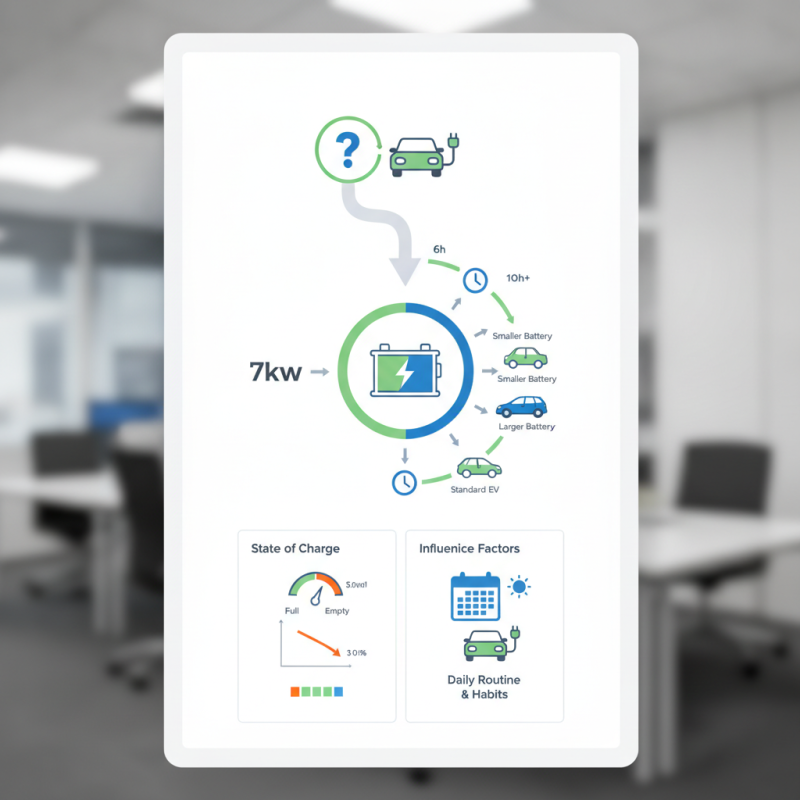
When considering electric vehicle (EV) charging, many drivers ask, "How long does a 7kW charger take to fully charge an EV?" According to Dr. Emily Johnson, an expert in electric mobility solutions, "The charging time can vary significantly based on vehicle battery size." This variability can be influenced by many factors, including battery capacity and the state of charge at the start.
A 7kW charger is a common option for home charging. Typically, it can charge a standard EV in about 6 to 8 hours. However, larger batteries may require more time. For instance, a 60 kWh battery could take around 8 hours to reach full capacity. On the other hand, a smaller battery might charge faster. It’s essential to note that charging rates can decrease as the battery approaches full capacity, making precise predictions challenging.
Understanding these nuances is key for EV owners. Drivers should also consider their daily routines and charging habits. If they're not rushing, overnight charging is often convenient. There's no one-size-fits-all answer to "How long does a 7kW charger take to fully charge an EV?" Each situation involves unique variables that should be comprehended.
Understanding the Basics of EV Charging and Power Levels
The power level of an EV charger is crucial in determining charge time. A 7kW charger is often used for home charging. It delivers energy at a rate of approximately 7 kilowatts per hour. This means that a fully depleted 40 kWh EV battery can be charged in about five to six hours. However, various factors influence this time.
Battery state affects charging efficiency. The initial charging may be swift, but as the battery approaches full capacity, the charging slows down. This means that the last 20% could take significantly longer than the first 80%. According to a report by the International Energy Agency, charging time varies widely, depending on environmental conditions and the vehicle’s battery management system.
Not every situation is ideal. For instance, charging at home typically assumes a regular power supply. But not all households have dedicated circuits. Load management becomes essential. Additionally, many users may find themselves without access to a 7kW charger. They might have to rely on standard wall outlets, resulting in an extended charging duration. This emphasizes the need for adequate planning when it comes to EV ownership and charging.
The Charging Capacity of a 7kW Charger in kWh and Time Calculation
A 7kW charger can deliver energy at a rate of 7 kilowatts per hour. This means that to calculate the time needed to fully charge an electric vehicle (EV), we must consider the vehicle's battery capacity, typically measured in kilowatt-hours (kWh). For instance, a common EV battery might have a capacity of around 50 kWh. At a charging rate of 7 kW, it would take approximately 7 hours to fully charge this battery from empty.
Data from industry reports indicates that charging speeds can significantly vary based on factors such as battery condition, ambient temperature, and charger efficiency. While the theoretical time is straightforward, real-world conditions may result in longer charging periods. For example, higher temperatures can reduce charging efficiency, potentially extending the charging time. Meanwhile, if the vehicle's battery is partially charged, the time required decreases.
Moreover, the acceptance rate of an EV’s battery may not always align with the charger's output. As the battery fills up, the charging speed generally decreases, often entering a trickle charge phase as it approaches completion. This variability adds complexity when predicting charging times. Understanding these nuances can help EV owners better manage their charging needs, ensuring they maximize their vehicle's performance and lifespan.
Factors Affecting Charging Time: Battery Size and State of Charge
Charging an electric vehicle (EV) with a 7kW charger can be influenced by several factors.
The battery size is a crucial element. Larger batteries naturally require more energy to charge fully. For instance, a
60 kWh battery can take roughly 8-10 hours to charge from empty. On the contrary, a smaller
30 kWh battery might only need about 4-5 hours. This variance is substantial, showing how battery capacity directly affects charging times.
The state of charge also plays a significant role. If an EV's battery is at 20%, it will charge more quickly than if it were at 5%.
Charging slows as the battery nears full capacity to protect battery health. Details matter here; some drivers may forget this. Ignoring the state of charge may lead to unexpected wait times.
Additionally, environmental factors, like temperature, can impact efficiency. Cold weather often reduces charging speed, which many overlook.
Understanding these factors is crucial for optimizing the EV charging experience.
Real-World Examples of Charging Times for Various EV Models
Charging an electric vehicle (EV) with a 7kW charger can vary significantly. This variance largely depends on the battery capacity of the EV. For example, a typical EV with a 40 kWh battery can be charged in about six hours. This means convenient overnight charging is possible for many users.
For larger batteries, the charging time increases. An EV with an 80 kWh battery may take roughly 11 to 12 hours to achieve a full charge. In a real-world scenario, this can pose a challenge for those who need quick turnarounds. Additionally, environmental factors such as temperature can influence charging efficiency. Cold weather often slows down charging, leading to longer wait times.
It's essential to consider user habits as well. If someone drives over 300 miles daily, a 7kW charger may not suffice. For those drivers, fast-charging options might be necessary. Still, a 7kW charger is often ideal for overnight home charging. Understanding personal usage is vital for optimizing charging times and ensuring drivers are ready for the road. Charging times can feel frustrating, but planning can help.
How long does a 7kW charger need to fully charge an EV? - Real-World Examples of Charging Times for Various EV Models
| Electric Vehicle Model |
Battery Capacity (kWh) |
Charging Time (hours) |
| Model A |
50 |
7 |
| Model B |
60 |
8.5 |
| Model C |
75 |
10.5 |
| Model D |
80 |
11.5 |
| Model E |
100 |
14 |
Comparative Analysis: 7kW Chargers vs. Other Charger Types
When considering charging options, a 7kW charger stands out among its peers. For many electric vehicle (EV) owners, the charging speed is a critical factor. A 7kW charger can fully charge most EVs in six to eight hours. This makes it ideal for overnight charging at home. Other charger types, like 3.6kW or 22kW, vary significantly in charging time. A lower-powered charger may take up to twelve hours for a full charge, while a 22kW unit could complete it in three to four hours.
However, charging speed is not the only consideration. Not every location supports higher kW chargers. Charging infrastructure can be inconsistent. In some areas, 7kW chargers may be the best option available. Drivers sometimes find themselves waiting longer at public stations that offer slower charging. This unpredictability can lead to charging anxiety. Additionally, not all vehicles utilize the full potential of rapid chargers. Some EVs may only accept lower wattages, rendering higher-output chargers less effective.
There's a balance to consider here. While the 7kW charger provides efficiency, it may not suit all charging scenarios. Some users might rush for quick charges during travel, only to find themselves at a slower station. As the industry evolves, understanding these nuances is essential for optimizing your charging experience.
FAQS
: It typically takes about five to six hours.
Battery state, size, and environmental conditions all play a role.
To protect battery health, charging speed decreases as it approaches full capacity.
Larger batteries require more energy; for example, a 60 kWh battery takes 8-10 hours to charge.
Yes, cold weather can reduce charging efficiency, often leading to longer wait times.
You might need to use standard wall outlets, which can considerably extend charging time.
Charging is faster from 20% compared to 5% due to reduced efficiency as batteries fill.
It often works well for many, but not for those who drive over 300 miles daily.
Understand your driving habits, battery size, and available charging options for efficient planning.
Not all homes have dedicated circuits, making load management important for efficient charging.
Conclusion
The article explores the question, "How long does a 7kW charger take to fully charge an EV?" by first explaining the fundamentals of EV charging and different power levels. It details how a 7kW charger contributes to the overall charging process, highlighting the calculations involved in determining charging time based on the charger’s capacity in kWh and the vehicle's battery requirements.
Additionally, the article examines various factors that influence charging times, such as the battery size of the electric vehicle and its current state of charge. By providing real-world examples, it compares the performance of 7kW chargers against other types of chargers, offering insights into their efficiency and practicality for everyday use. This comprehensive analysis aims to equip readers with a clearer understanding of the nuances affecting the charging duration of electric vehicles.
 VoltNode Charger
